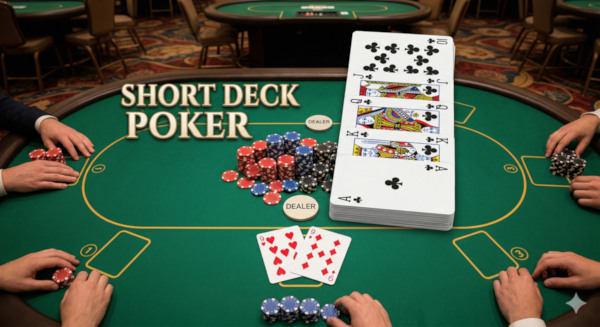
Poker has never been a static game. New formats appear, old variants return in fresh form, and players are always looking for versions that deliver more action, bigger pots, and new strategic challenges. One of the most exciting examples is Short Deck Poker, a fast-paced variant that has become especially popular among high-stakes players and online poker fans.
Also known as 6+ Hold’em, Short Deck Poker looks familiar at first glance. The game uses the same basic structure as Texas Hold’em: each player receives two hole cards, five community cards are dealt face up across the board, and the best five-card hand wins at showdown. However, one major change transforms the entire game: the deck is reduced.
In Short Deck Poker, all 2s, 3s, 4s, and 5s are removed from the deck. That leaves just 36 cards, which dramatically changes hand values, drawing odds, equities, and overall strategy. Strong hands appear more often, draws behave differently, and the action tends to be much more aggressive than in standard Hold’em.
For players who enjoy dynamic poker with constant pressure and closer equities, Short Deck can be incredibly appealing. But while the format is easy to learn for anyone familiar with Texas Hold’em, it is not something you should approach without preparation. The smaller deck changes more than most beginners realize.
This guide explains exactly what Short Deck Poker is, how it works, what the hand rankings look like, how it differs from regular Hold’em, and what strategy adjustments matter most.
Short Deck Poker is a poker variant based on Texas Hold’em but played with a 36-card deck instead of the standard 52-card deck. All cards ranked 2 through 5 are removed, so the deck contains only cards from 6 through Ace.
That one adjustment changes the game in several important ways.
First, because there are fewer cards in the deck, players make strong hands more often. Pairs, trips, straights, and full houses become more common, which means the relative value of one-pair and two-pair hands shifts. Second, drawing situations change because the number of unseen cards is smaller. Third, preflop equities between hands tend to run closer together, which encourages more all-in confrontations and aggressive play.
Short Deck Poker is commonly referred to as 6+ Hold’em because the lowest card left in the deck is the six. In most formats, the game still follows the same broad rules as No-Limit Texas Hold’em, but many rooms introduce special hand-ranking adjustments to reflect the altered probabilities.
Over the last several years, Short Deck has earned a reputation as a high-action poker format that rewards adaptability. It is attractive to recreational players because it creates more dramatic boards and bigger hands, and it appeals to experienced players because it forces them to rethink familiar poker logic.
At a structural level, Short Deck Poker works very much like standard Hold’em.
Each player receives:
Then the dealer places:
There are betting rounds:
At showdown, the best five-card poker hand wins.
That sounds simple enough, but the reduced deck changes the game far more than the familiar layout suggests.
Because low cards are removed, the distribution of remaining ranks becomes denser. High-card combinations appear more frequently. Connected cards gain importance. Big Broadway-heavy hands become even more playable. Draws often have more value than newcomers expect, and marginal made hands can become dangerous if overplayed.
Another important point is that Short Deck Poker is not perfectly standardized across all operators. Different poker rooms may use:
That means you should always check the exact rules of the game before joining, especially if you are switching between sites or live venues.
Although the game resembles Texas Hold’em, there are several core rules every player needs to understand before sitting down.
The defining rule of Short Deck Poker is the reduced deck.
Cards removed:
Cards remaining:
With four suits for each of those nine ranks, the deck contains 36 cards in total.
This changes everything from preflop hand values to postflop drawing power. Since there are fewer total cards, it becomes easier to connect with the board. At the same time, some types of draws become more or less valuable depending on how hand rankings are defined in that specific game.
Short Deck Poker often uses a betting structure that differs from standard Hold’em cash games.
In many versions, the game is played with:
This setup creates bigger pots before the cards are even dealt, which encourages more aggressive play and more contested hands.
Some poker rooms, however, still use more familiar blind structures. Because formats vary, you should never assume the betting setup is identical everywhere.
The ante-heavy structure is one reason why Short Deck tends to produce more action. Players are incentivized to fight for dead money already in the pot, and folding too often becomes more costly.
Dealing is straightforward:
The flop, turn, and river work just as they do in Hold’em. The difference lies not in how the board is dealt, but in how much more frequently it connects with players’ ranges.
Boards in Short Deck tend to be more coordinated. Big draws appear often. Strong made hands collide more regularly. That is part of what makes the format so exciting.
Hand rankings in Short Deck Poker are one of the most important things to learn, because they do not always match standard Texas Hold’em rules.
This is where many beginners make costly mistakes.
In traditional Hold’em, hand rankings from strongest to weakest are:
In Short Deck, some rooms change these rankings because certain hands become more common or less common with a 36-card deck.
The two most common adjustments are:
Not every operator uses both changes, but many use at least one of them. That is why checking the rule set before playing is absolutely essential.
A common Short Deck ranking system looks like this:
In some rooms, however, only the flush/full house relationship is changed, while straights may still rank above trips. In others, the traditional order is altered in different ways.
Another detail to know is the lowest straight. Since the deck starts at six, some versions recognize A-6-7-8-9 as the lowest straight. This rule can be unfamiliar to players coming from standard Hold’em, so it is worth remembering.
The broader lesson is simple: in Short Deck Poker, never rely purely on standard Hold’em instincts when reading hand strength.
Short Deck and Texas Hold’em share the same backbone, but they play very differently in practice.
The most obvious difference is the deck size.
With fewer cards in play, combinations change more rapidly, hand strengths shift, and equities compress.
Because the card pool is smaller, players hit boards more often. Certain made hands and drawing combinations appear at a higher frequency than in full-deck Hold’em.
This means that what counts as a strong holding in standard Hold’em may not always be strong enough in Short Deck.
High cards show up more often, and connected textures are common. That leads to more boards where multiple players can make strong hands or powerful draws at the same time.
As discussed above, many Short Deck games use modified hand rankings. This single factor can completely change optimal decision-making.
In Short Deck, preflop equities tend to run closer. That means the mathematical gap between a favorite and an underdog is often smaller than in standard Hold’em. As a result, all-in confrontations can feel swingier, and aggression becomes more common.
The ante-heavy structure, smaller deck, and closer equities combine to create a game that usually plays looser and faster than standard Hold’em. Players defend more, attack more, and commit chips more willingly.
The name 6+ Hold’em comes directly from the composition of the deck.
Since all cards below the six are removed, the game is played using only:
In other words, the deck begins at 6 and above, which is why the game is called 6+.
The term is commonly used interchangeably with Short Deck Poker, and both names refer to the same general variant. In marketing and poker-room menus, you may see either title depending on the platform.
One of the biggest mistakes beginners make is assuming standard Hold’em math still applies in Short Deck. It does not.
The reduced deck changes probabilities in ways that affect every stage of the hand.
With fewer ranks in the deck, it becomes easier to make pairs, trips, straights, and full houses. This means that hand values must be judged relative to a stronger average showdown range.
A hand that looks strong in full-deck Hold’em may be far less impressive in Short Deck if the board structure heavily favors stronger combinations.
Because the ranks are more tightly packed, connected cards gain value and straights show up frequently. This is one reason why many Short Deck games rank three of a kind above a straight. If straights are easier to make, their value naturally decreases.
A flush may be ranked above a full house in many Short Deck games because it can be statistically harder to make under that format’s structure. This is another example of why traditional instincts do not always carry over cleanly.
In standard Hold’em, premium pairs often dominate weaker holdings quite clearly. In Short Deck, those edges tend to shrink. A big pair is still strong, but it is often less dominant than players expect.
That leads to more action and more variance. Preflop confrontations that would feel straightforward in Hold’em can become more marginal in 6+ Hold’em.
Because players connect with the board more often and equities stay closer, strong draws can have enormous value. Combo draws, pair-plus-draw situations, and redraw-heavy hands become especially important.
The key takeaway is that Short Deck requires its own mathematical mindset. You do not need to memorize every probability to start playing well, but you do need to accept that standard Hold’em assumptions can mislead you.
Short Deck is not just Hold’em with a few cards missing. To play it well, you need to adjust your overall approach.
Aggression is a major part of winning Short Deck strategy.
Because:
players are generally rewarded for taking initiative.
Open-raising, 3-betting, semi-bluffing, and value-betting aggressively are all central parts of strong Short Deck play. Waiting too long for absolute premium situations usually means giving up too much equity and too much dead money.
Starting hand values change significantly in Short Deck.
In regular Hold’em, some medium-strength hands rely on dominating weaker ranges or making top pair with a strong kicker. In Short Deck, that logic becomes less reliable because:
Hands with strong connectivity and high-card strength often perform very well. Broadway combinations, suited high cards, and hands with straight-making potential gain importance.
Players in action-heavy formats often call too much and overestimate medium-strength hands. That creates opportunities for value betting. At the same time, because strong hands are more common, you need to be realistic about what your one-pair or two-pair hands are actually worth.
In Short Deck, value betting is crucial, but hand reading must be sharper. Thin value spots can still exist, yet careless overvaluation is punished quickly.
If you come from standard Hold’em, you may underestimate just how live many drawing hands are in Short Deck. Open-enders, combo draws, and pair-plus-draw holdings can carry tremendous equity. Giving free cards or making overly passive decisions against drawing-heavy ranges can be expensive.
This sounds basic, but it is one of the most important strategic rules in the game. If you are not 100% clear on whether a flush beats a full house or whether trips beat a straight in your game, you are not ready to play for real money.
A surprising number of mistakes in Short Deck come not from advanced theory errors, but from simple confusion about which hand is actually stronger.
There is no universal preflop chart that fits every Short Deck game, because the structure, position sizes, and rule variations matter. Still, some broad principles apply consistently.
Big pairs remain strong starting hands. Aces, kings, and queens are still premium holdings, especially heads-up or in shallow-stacked situations.
However, do not assume they are as invulnerable as in standard Hold’em. Because equities run closer and boards are more dynamic, overpairs need more careful postflop handling.
Hands like:
become extremely valuable because the deck is dense with high cards. These hands make top pair often, connect with strong straight structures, and can generate powerful equity across many runouts.
Connected hands gain significant value in Short Deck because straights become more common. Holdings with strong connectivity can create disguised monsters and huge drawing situations.
Hands containing cards like 9-10, 10-J, J-Q, and Q-K often perform better than inexperienced players assume.
Depending on the exact hand-ranking rules, suited hands may gain extra value because flushes can be especially strong in some versions of the game. Even when flushes are not ranked above full houses, suited connectivity remains attractive because of the drawing power it creates.
One of the biggest differences between strong and weak Short Deck starting hands is the ability to make nutted or semi-nutted combinations. Hands that can make strong pairs, strong straights, and powerful draws tend to outperform disconnected or dominated holdings.
Short Deck may be easy to learn, but it is also easy to misplay. Here are some of the most common mistakes beginners make.
This is the biggest error of all. Players assume their Hold’em experience will transfer directly, then make poor folds, bad hero calls, or flawed value bets because they are applying the wrong framework.
If you forget that a flush beats a full house in your game, or that trips beat a straight, you can make catastrophic mistakes. Always learn the ranking system before playing.
Top pair and overpairs are still useful hands, but they are not the same monsters they can be in some Hold’em spots. In Short Deck, players make stronger hands more often, so stubborn attachment to one-pair holdings is dangerous.
Many newcomers treat drawing hands too lightly and fail to recognize how much equity they really carry. This leads to poor bet sizing, passive lines, and incorrect all-in decisions.
The structure of Short Deck usually rewards aggression more than passivity. Limping too often, calling too much, and missing spots to attack can be a major leak.
Ante-only or button-ante structures change incentives dramatically. Players who fail to account for preflop dead money often play far too tight.
That depends on what you mean by “harder”.
For a player who already knows Texas Hold’em, Short Deck is relatively easy to learn at a basic level. The same overall flow is there:
So the format feels familiar almost immediately.
However, Short Deck can be harder to master because many standard assumptions stop working. You need to adjust to:
In that sense, Short Deck is strategically demanding. It rewards players who can adapt quickly and who are comfortable operating in volatile, high-pressure spots.
For complete beginners to poker, standard Hold’em is usually the easier place to start because it is more widely available and strategically more documented. But for experienced Hold’em players, Short Deck offers an exciting and intellectually challenging alternative.
Short Deck’s popularity is easy to understand once you play a few sessions.
Fewer cards and closer equities mean players are more willing to put money into the pot. There is less waiting around for perfect situations and more frequent confrontation.
The ante-based structure builds pots immediately, and the strong equity of many holdings encourages players to continue aggressively.
Short Deck produces a lot of dynamic boards with draws, pair-plus-draw combinations, and strong made hands. That creates the kind of dramatic poker moments many players enjoy.
For experienced players, Short Deck offers something beyond routine Hold’em grinding. It forces them to rethink hand values, adjust ranges, and explore a more volatile game tree.
From a recreational perspective, Short Deck often feels more fun. More hands develop into big spots, which creates a faster and more exciting experience.
Short Deck Poker is available at selected online poker rooms and occasionally appears in live poker festivals, cash games, and high-stakes events. Availability depends on the operator, the region, and current traffic.
Before choosing where to play, it is smart to compare:
Because Short Deck is not as universally standardized as Texas Hold’em, the details matter. Two platforms may both offer “Short Deck Poker”, but the experience can still vary significantly depending on the rules and game format.
Short Deck Poker is a variation of Texas Hold’em played with a 36-card deck. All 2s, 3s, 4s, and 5s are removed, which changes hand probabilities, hand values, and strategy.
Yes. Short Deck Poker and 6+ Hold’em are two names for the same general poker variant.
There are 36 cards in the deck.
In many versions, yes. But rules vary by poker room, so you should always check the exact hand rankings before playing.
It is easier to learn for Hold’em players because the structure is familiar, but it can be harder to master because of different equities, rankings, and strategy adjustments.
Premium pairs, big Broadway hands, connected high cards, and suited holdings with strong combo potential are usually among the strongest starting hands.
Because the deck is smaller, equities are closer, and many formats use antes that build larger pots preflop. This encourages more action and more frequent chip commitment.
Short Deck Poker is one of the most exciting modern poker variants because it combines the familiar structure of Texas Hold’em with a dramatically different strategic environment. By removing all cards from 2 through 5, the game creates stronger average hand strengths, closer equities, more draws, and much more aggressive action.
That is exactly why Short Deck has become so popular with both recreational players and serious grinders. It is fast, volatile, entertaining, and strategically rich. But it is also a format that punishes lazy assumptions. You cannot simply import your standard Hold’em habits and expect everything to work the same way.
If you want to succeed in Short Deck Poker, start with the basics. Learn the deck structure. Confirm the hand rankings. Understand how the betting format works. Then adjust your hand selection, your aggression, and your postflop thinking accordingly.
For players willing to make those adjustments, 6+ Hold’em offers a fresh and highly rewarding poker experience.